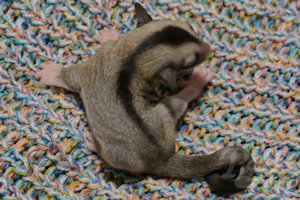
Updated information about Caramel sugar gliders, including appearance, temperament, breeder-community classification, and breeding cautions.
Updated Note
How This Page Uses the Term “Caramel”
In the sugar glider pet and breeder community, “Caramel” is commonly used to describe a distinct Indonesian line or subspecies-type population, not simply a coat color of standard captive sugar gliders.
Current scientific classification of captive sugar gliders is more complicated than breeder terminology. This page uses “Caramel” in the breeder/community sense while noting that sugar glider taxonomy has changed and continues to be studied.
Overview
What are Caramel sugar gliders?
Caramel sugar gliders are commonly described in the breeder community as originating from the Merauke area of Irian Jaya, Indonesia and entering U.S. breeding programs around October 2009. In breeder language, they have often been treated as a distinct subspecies-type group rather than a standard sugar glider color variation.
They are still relatively uncommon compared with many standard captive color lines. Their popularity increased as more breeders became interested in working with them, but responsible breeding requires special caution because Caramels are not generally treated as compatible with standard captive sugar glider lines.
Caramel sugar gliders are commonly described as being larger and heavier-bodied than standard captive sugar gliders. They are often described as about 20% larger than many standard captive sugar gliders, with a caramel-colored body, white hands, and a cream-colored face.
Many keepers also describe Caramels as having a thicker or fluffier tail and a softer caramel, champagne, or warm brown tone. Exact appearance can vary by individual, age, lighting, and line.
Their vocalizations are also often described as different from standard captive sugar gliders, sometimes sounding deeper or raspier.
Caramel sugar gliders are often described as having docile personalities, which is one reason they are appealing to some keepers. Many breeder/community descriptions also describe Caramels as calm or easygoing.
Temperament is never guaranteed by line alone. Handling, socialization, housing, stress, age, health, and individual personality still matter. A Caramel sugar glider should receive the same patient bonding process as any other sugar glider.
Caramel sugar gliders have the same general husbandry needs as other sugar gliders. They need a safe cage, proper diet, social housing, enrichment, bonding time, veterinary care, nail maintenance, and safe pouches and toys.
Because they may be larger than some standard captive sugar gliders, owners should be thoughtful about cage space, wheel size, sleeping pouch size, and general enrichment. Larger body size does not change the basic care requirements, but it may affect what equipment feels comfortable and appropriate.
Sugar glider terminology has often used simple labels such as “standard sugar glider” and “Caramel subspecies.” Newer research shows that the broader sugar glider classification is more complex than that.
A 2019 genetic study found that sampled U.S. captive sugar gliders traced back to West Papua, Indonesia, rather than Australia or Papua New Guinea. More recent taxonomic work has also suggested that captive populations in the United States and Europe may be more closely aligned with a New Guinean lineage than the narrower Australian Petaurus breviceps concept.
Because of this, it is safer to describe Caramels as a breeder/community line or subspecies-type population unless discussing a specific scientific classification from a current source. The important practical point for owners and breeders is still the same: Caramels should not be casually mixed into standard captive breeding lines.
Should Caramels be bred to standard sugar gliders?
No. Caramel sugar gliders should generally be bred only to other Caramel sugar gliders. Breeder experience has consistently warned that male offspring from Caramel-to-standard sugar glider pairings may be sterile.
Many breeders have also reported sterile males from Caramel-to-standard pairings. This is commonly explained in the breeder community as likely being related to Caramels coming from a different subspecies-type population or genetically distinct line from standard captive sugar gliders.
Even if the exact scientific classification is complicated, the responsible breeding recommendation remains conservative: do not breed Caramels into standard captive sugar glider lines.
Some keepers have housed standard captive sugar gliders with Caramel sugar gliders in pet-only colonies or pairs. Pet-only housing is different from breeding.
If Caramels are housed with standard captive sugar gliders, breeding must be prevented. That generally means neutering males and carefully managing introductions, compatibility, and long-term colony safety.
As with any sugar glider introduction, personality, scent, age, sex, space, and stress matter. Introductions should be slow, supervised, and based on safety rather than convenience.